
Every year, thousands of families in Italy face significant non-university education expenses: tuition fees, canteen charges, transport, school trips. Many are unaware that a substantial portion of these costs can be deducted in their income tax return. Studio Lombardo Larosi has prepared this complete and up-to-date guide to help you understand exactly what you can deduct, how much, and how to do it correctly.
What are deductible non-university education expenses?
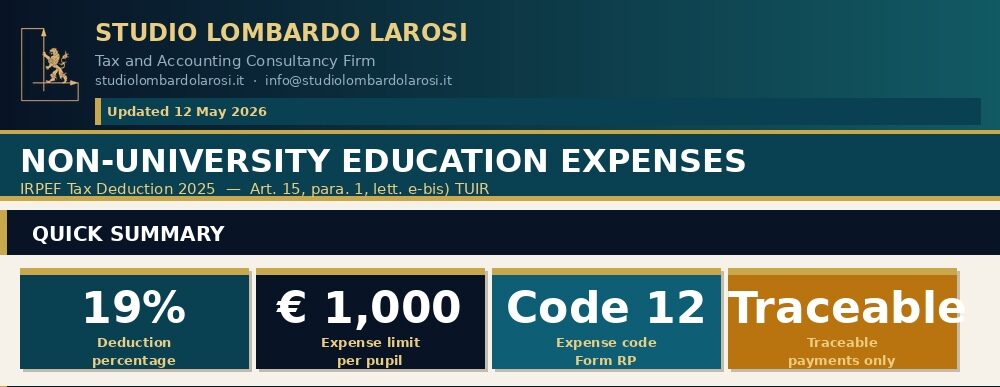
Italian law — specifically Art. 15, paragraph 1, lett. e-bis) of the TUIR — allows taxpayers to deduct 19% of non-university education expenses incurred for the schooling of their children or other fiscally dependent family members. The deduction applies to schools of all levels: from nursery through to upper secondary, whether state-run, accredited private, or run by local authorities.
The maximum deductible expenditure is €1,000 per pupil or student (threshold in force from 2025), giving a maximum effective deduction of €190 per child.
Which schools qualify for the non-university education expenses deduction?
The deductible non-university education expenses relate to attendance at:
- Nursery and kindergarten schools
- First-cycle schools (primary and lower secondary)
- Upper secondary schools (academic, technical and vocational)
Both state schools and accredited private institutions fall within the scope of the legislation. Attendance at secondary schools abroad, however, is not deductible.
Non-university education expenses: what can you deduct beyond tuition fees?
Many families only consider enrolment fees or annual tuition, overlooking the fact that the range of deductible non-university education expenses is considerably broader. The following costs also fall within the deductible limit:
- School canteen — even when the service is managed by a third-party provider
- Supplementary services — such as before-school and after-school care, and meal supervision
- School trips and school insurance
- Contributions approved by school governing bodies for the expansion of educational activities — language courses, theatre, extracurricular activities
- School transport — even when organised by the municipality or third parties
What does NOT qualify as deductible non-university education expenses
To avoid errors in your tax return, it is important to know that the following costs are excluded from deductible non-university education expenses:
- Purchase of textbooks, musical instruments, and stationery
- Board, lodging, and travel to reach the school
- Attendance at secondary schools abroad
Who can benefit from the non-university education expenses deduction?
The deduction for non-university education expenses is available to the taxpayer who bears the cost, even if the receipt is made out to a spouse, child, or other fiscally dependent family member. There are, however, specific rules on how the deduction is shared between parents:
- If the receipt is in one parent’s name, that parent claims the full amount
- If it is made out directly to the fiscally dependent child, the deduction is split 50/50 between both parents
- If the cost was borne in a proportion other than 50/50, the agreed split must be noted on the receipt
Important: the deduction cannot be combined with charitable donations
One frequently overlooked aspect concerns the incompatibility with another tax benefit: anyone claiming a deduction for non-university education expenses cannot also deduct charitable donations made to the same institution for the purpose of expanding its educational offering. This incompatibility applies at the level of the individual pupil: if you have two children, you may claim the attendance deduction for one and the charitable donation deduction for the other.
How to report non-university education expenses in your tax return
Non-university education expenses must be entered in the REDDITI PF form, Section RP, lines RP8–RP13, using expense code 12. If the expenses relate to more than one child, a separate line must be completed for each pupil, each with its own €1,000 limit.
What documents to keep for the non-university education expenses deduction
To substantiate deductible non-university education expenses, all payments must be traceable (bank transfer, postal order, credit or debit card). The documents to retain vary depending on the type of expenditure:
- Tuition fees and enrolment charges: receipts or proof of payment
- Canteen and supplementary services: bank transfer receipt or postal order showing the service, school name, and pupil’s name; or a certificate issued by the school or service provider
- School trips, insurance, and contributions for educational activities: receipts showing the pupil’s details; if payment was made to a third party, a school authorisation document showing the governing body’s resolution is also required
Restructuring of deductions from 2025: what changes for higher earners
From 2025, new rules have come into force that limit deductions for higher-income taxpayers. The deduction for non-university education expenses is also affected by these changes. Specifically:
- For income between €120,000 and €240,000: the deduction is progressively reduced
- For income above €75,000: all deductions, including the one for school expenses, are subject to an overall cap that may reduce the effective amount claimable
Download the infographic PDF
Need help claiming the non-university education expenses deduction?
Navigating expense codes, income thresholds, and incompatibility rules related to non-university education expenses can be complex. Studio Lombardo Larosi is here to help you verify the deductions you are entitled to, complete your tax return correctly, and make sure you do not miss any tax benefit. Contact us at info@studiolombardolarosi.it for a personalised consultation.

Studio Lombardo Larosi — Tax and Accounting Consultancy Firm
We help you claim every deduction you are entitled to — accurately, efficiently, and without stress.