
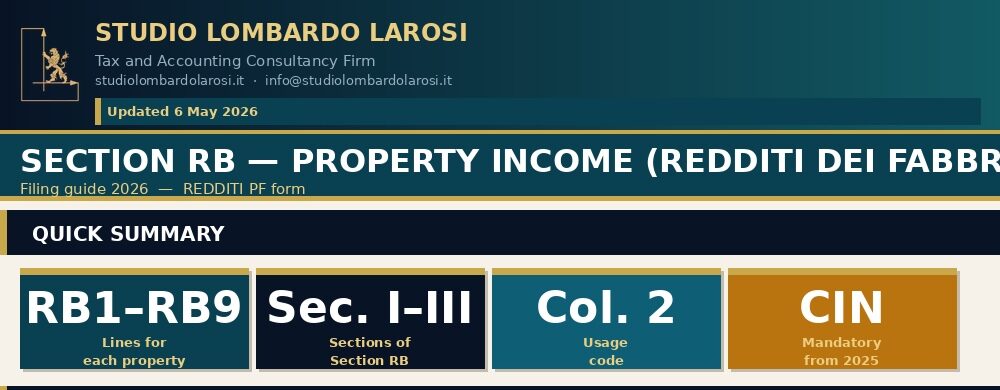
If you own one or more properties in Italy, correctly declaring your property income is one of the most important tax obligations of the year. Errors in completing Section RB can result in penalties, tax assessments, or the loss of tax benefits. In this complete guide, Studio Lombardo Larosi walks you through how Section RB of the REDDITI PF 2026 form works, what data to enter, and how to avoid the most common pitfalls.
Table of Contents
What is property income and who must declare it
Property income refers to the income — actual or deemed — arising from ownership of residential or commercial properties located in Italy. Anyone who owns, even partially, a residential, commercial, or business property on Italian soil is required to declare it. Properties located abroad are excluded from Section RB and must instead be reported in Section RL.
The obligation applies both to full owners and to co-owners, who must state their ownership percentage. Even those who receive no rental income — for example because the property is kept at their disposal or made available free of charge to a family member — are still required to declare property income based on the updated cadastral value.
Section RB of the REDDITI PF form: structure and parts
Section RB is the part of the REDDITI Persone Fisiche form dedicated to declaring property income. It is divided into three main parts:
- Part I (lines RB1–RB9): property income entries — one line per property owned
- Part II (line RB11): rental contract data, with totals for flat-rate tax (cedolare secca)
- Part III (lines RB24–RB25): National Identification Code (CIN) for properties used for tourist or short-term lets, mandatory from 1 January 2025
Line RB10 provides an overall summary of all income types and flat-rate tax totals, serving as the consolidation row for the entire section.
How to complete property income: column by column
Each line in Part I contains several columns. Here is what to enter in each one:
| Column | Description | Notes |
| 1 — Cadastral value | Non-updated cadastral value of the property | For listed/historic properties: 50% reduction applies |
| 2 — Usage | Code indicating how the property is used | Codes 1 to 15: see usage code table below |
| 3 — Days | Days of ownership during the year | 365 if owned for the full year |
| 4 — Percentage | Ownership share as a percentage | 100 if sole owner |
| 5 — Rental income code | Method of taxation for the rental income | 1=std.95%, 2=std.75%, 3=flat tax 100%, 4=historic 65% |
| 6 — Rental income | Taxable portion of the annual rent | In co-ownership: always enter the full rental amount |
| 7 — Special cases | Code for special situations (uninhabitable, unpaid rent, etc.) | Codes 1 to 8 |
| 8 — Continuation | Tick if the line refers to the same property as the line above | Used when one property spans multiple lines |
| 9 — Municipality code | Cadastral code of the municipality where the property is located | E.g. H501 = Rome, F205 = Milan |
| 11 — Flat tax | Type of rental under flat-rate tax (cedolare secca) | 1=standard 21%-10%, 2=short-let 21%, 3=short-let 26% |
| 12 — IMU special cases | Special IMU/IRPEF situations | 1, 2 or 3 depending on the circumstance |
| 13–19 — Income | Amount of income declared | Complete only on the first line for each property |
| 20 — Other data | Code 1 for agreed-rent contracts with flat tax in disaster-affected or seismic red-zone municipalities | See ministerial guidelines |
Property usage codes: complete guide for property income
Column 2 (Usage) is one of the most critical when completing the property income declaration. Selecting the wrong code can result in incorrect taxation. Here are the main codes:
- Code 1 — Taxpayer’s primary residence
- Code 2 — Property held at disposal (not let, not used as primary residence)
- Code 3 — Let at market rate (including partial lets or periods under 30 days)
- Code 4 — Let at a legally determined rent
- Code 5 — Accessory to the primary residence (garage, cellar, etc.) with its own cadastral value
- Code 6 — Property used partly as primary residence and partly for a professional activity
- Code 8 — Let at an agreed rent in high-density municipalities, or with flat tax in disaster-affected or 2016 seismic red-zone municipalities
- Code 9 — Other cases, including accessories to short-let properties (in the latter case, rental income is reported only for the dwelling)
- Code 10 — Property on free loan to a family member, or used as primary residence by one of the co-owners
- Code 11 — Primary residence partly let at market rate
- Code 14 — Property in Abruzzo let to residents of earthquake-affected areas
- Code 15 — Property in Abruzzo on free loan (comodato d’uso)
Flat tax (cedolare secca): when it pays off and how to declare it in property income
The flat tax (cedolare secca) is an optional tax regime that replaces IRPEF, regional and municipal surtaxes, as well as stamp duty and registration tax on the rental contract. It applies exclusively to residential properties and provides three distinct rates:
- 21% — for standard market-rate rental contracts and short-term lets
- 10% — for agreed-rent contracts in high-density residential municipalities
- 26% — for short-term lets from the second property let in the same year (applicable from 2024)
When opting for the flat tax, enter code 3 in column 5 and the appropriate code in column 11 (1, 2, or 3 depending on the type of rental). The amount to enter in column 6 is 100% of the agreed rent, regardless of the ownership share in the case of co-ownership.
Property income and IMU: the substitution effect you cannot ignore
One of the most complex aspects of the property income declaration concerns the relationship with IMU (the municipal property tax). As a general rule, for unlet properties subject to IMU, the latter substitutes IRPEF — meaning the income does not need to be subject to income tax as well. However, there are important exceptions, coded in column 12 (IMU special cases):
- Code 1 — Property other than the primary residence that is exempt from IMU but still subject to IRPEF (e.g. agricultural land in certain municipalities)
- Code 2 — Primary residence and accessories subject to IMU (luxury properties: cadastral categories A/1, A/8, A/9)
- Code 3 — Unlet residential property in the same municipality as the primary residence: IRPEF applies at 50% of the updated cadastral value
Understanding this mechanism correctly is essential to avoid paying twice — or conversely, failing to declare income that is actually subject to IRPEF.
Most common special cases when declaring property income
Column 7 contains codes for situations that deviate from the standard. Here are the most frequently encountered cases:
- Code 1 — Property destroyed or uninhabitable due to an earthquake or natural disaster
- Code 3 — Uninhabitable unit for which a cadastral value revision has been requested
- Code 4 — Let property for which no rent has been received (useful in cases of tenant arrears)
- Code 5 — Co-owned property let to one of the owners
- Codes 6, 7, 8 — Downward rent renegotiation, with or without notification to the Revenue Agency, in various situations involving arrears or co-ownership
The National Identification Code (CIN) from 2025: what changes for property income
From 1 January 2025 it is mandatory to include the National Identification Code (CIN) in Section RB. The CIN is issued by the Ministry of Tourism and is required for all properties used for tourist or short-term lets, as well as for hotel and non-hotel accommodation. This requirement applies to Part III of Section RB (lines RB24 and RB25) and forms part of the broader regulatory framework aimed at governing the short-let market in Italy.
Anyone who rents their apartment through online platforms (Airbnb, Booking.com, etc.) for periods of less than 30 days must obtain a CIN and include it in their property income declaration. Failure to do so may result in administrative penalties.
Practical example: completing Section RB
Consider a self-employed professional who uses their flat both as their primary residence and partly for their professional activity. In this case, usage code 6 applies in column 2. The cadastral value (e.g. €516.00) is entered in column 1 with 365 days of ownership and 100% ownership share. The 50% of income attributable to the professional use of the primary residence is declared under standard taxation but may be deducted within the self-employment income section at line RE10.
This example clearly illustrates how the declaration of property income can interact with other sections of the tax return, requiring an overall view of the taxpayer’s complete fiscal position.
Why you should trust a professional with your property income return
The rules governing property income in Italy are dense with exceptions, codes, and interactions with other taxes such as IMU, IRPEF, and the flat-rate tax. A mistake in selecting the usage code, calculating the taxable rent, or handling the IMU substitution effect can result in penalties or a tax audit. Studio Lombardo Larosi provides comprehensive assistance with completing Section RB and managing all tax obligations connected to property ownership in Italy. We are here to help you avoid errors and optimise your tax position.
📧 Contact us at info@studiolombardolarosi.it for a personalised consultation.
Download the infographic PDF
Frequently asked questions (FAQ)
📌 Do I need to declare property income if my property is vacant?
➡️ Yes. Even an unlet property must be declared in Section RB based on its updated cadastral value, unless the IMU substitution effect applies.
📌 How is property income declared in cases of co-ownership?
➡️ Each co-owner completes their own Section RB stating their ownership percentage in column 4. However, the full rental amount must always be entered in column 6.
📌 What happens if I fail to declare property income?
➡️ Failure to declare exposes you to penalties ranging from 90% to 180% of the tax evaded, plus interest. In cases of an inaccurate return, penalties may be reduced through voluntary disclosure (ravvedimento operoso).

Property to declare in Italy? Trust Studio Lombardo Larosi
We guide you through the correct completion of Section RB and handle all your property tax obligations in Italy.