
From 2025, filing an Italian income tax return has become more complex for medium-to-high earners. The restructuring of deductions in the Italian tax return has introduced an overall cap on deductible expenses for taxpayers with total income above €75,000, fundamentally changing how tax benefits are calculated. In this guide, Studio Lombardo Larosi explains clearly how traceability, tapering and restructuring work — and how to avoid costly mistakes in your tax return.
Table of Contents
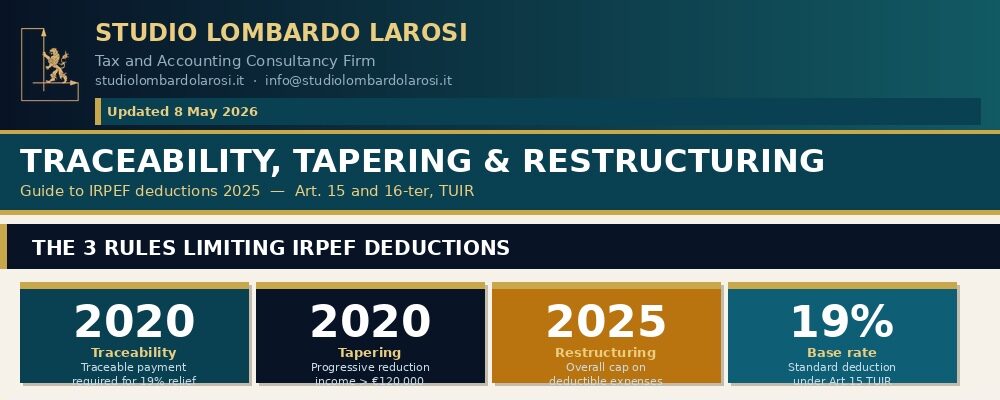
The three rules limiting IRPEF deductions: an overview
In recent years the Italian legislator has introduced three cross-cutting rules that apply — with certain exceptions — to the majority of deductible expenses in the tax return. Each of these rules can reduce or eliminate the deduction available to the taxpayer, regardless of how much was spent.
| Rule | In force from | Who it affects |
| Traceability of expenses for the 19% deduction | 2020 | All taxpayers |
| Tapering of the 19% deduction based on income | 2020 | Total income between €120,000 and €240,000 |
| Restructuring of deductions with an overall expense cap | 2025 | Total income above €75,000 |
The three measures are not mutually exclusive: in certain cases they apply in sequence, amplifying the overall reduction in available deductions. Let us look at each one in detail.
Traceability of expenses: when you lose your deduction without realising it
Since 2020, claiming the 19% deduction for expenses listed under Art. 15 of the TUIR requires that the payment was made by traceable means: bank or postal transfer, credit or debit card, cheque, or any other instrument that allows the transaction to be traced. Anyone who pays in cash forfeits the right to the deduction, even if the expense is entirely legitimate and properly documented.
Expenses exempt from the traceability requirement
The traceability requirement does not apply to the following categories of expenditure:
- Purchase of medicines and medical devices
- Healthcare services provided by public facilities
- Healthcare services provided by private facilities accredited to the National Health Service (SSN)
It should be noted that the traceability requirement applies exclusively to deductible expenses under Art. 15 TUIR — that is, those deductible at the 19% rate. It does not automatically extend to deductible costs (oneri deducibili) or to expenses deductible at rates other than 19%. However, specific categories such as charitable donations or building renovation bonuses have their own equivalent requirements under separate legislation.

Tapering of deductions: how the 19% rate changes for higher earners
Also in force since 2020, tapering applies to taxpayers with total income above €120,000. In these cases, the 19% deduction is not granted in full but reduced proportionally, until it is eliminated entirely when income exceeds €240,000.
The formula applied is as follows:
Effective deduction = Potential deduction × (240,000 – total income) ÷ 120,000
For example, with income of €150,000 and a potential deduction of €295, the effective deduction is: 295 × (240,000 − 150,000) ÷ 120,000 = 295 × 0.75 = €221.
Expenses exempt from tapering
- Healthcare expenses
- Interest on agricultural loans and mortgages
- Interest on mortgages for the purchase or construction of the primary residence
These items are always deducted in full, regardless of the taxpayer’s income level.
Restructuring of deductions in the Italian tax return: the major 2025 change
The restructuring of deductions in the Italian tax return is the most impactful measure introduced from 2025 and applies to anyone with total income above €75,000. Unlike tapering — which affects the value of each individual deduction — restructuring introduces an overall cap on the total sum of expenses eligible for deduction.
The maximum cap is calculated by multiplying two factors:
- Base amount: €14,000 for income between €75,000 and €100,000; or €8,000 for income above €100,000
- Children coefficient: 0.50 (no children), 0.70 (1 child), 0.85 (2 children), 1.00 (3 or more children, or at least one disabled child)
Once the cap is established, all deductible expenses are totalled. If the sum exceeds the limit, some expenses must be reduced or removed to bring the total within the cap, after which the deduction is calculated on each remaining item at its applicable rate. The Revenue Agency recommends retaining the expenses with the highest deduction rate — such as building renovation bonuses — and eliminating those at 19%, in order to maximise the taxpayer’s benefit. The taxpayer may however override this automatic logic by ticking the box marked “Non-automated restructuring of deductions”.
Table: maximum deductible expense cap by income and number of children
The table below summarises the maximum overall deductible expense following the restructuring of deductions in the Italian tax return, based on income level and the number of fiscally dependent children:
| Dependent children | Income between €75,000 and €100,000 | Income above €100,000 |
| No children | €7,000 | €4,000 |
| 1 child | €9,800 | €5,600 |
| 2 children | €11,900 | €6,800 |
| 3 or more children (or at least 1 disabled child) | €14,000 | €8,000 |
Important: these amounts represent the maximum threshold for deductible expenditure, not for the deduction itself. The effective deduction is obtained by applying the relevant rate (19%, 50%, etc.) to each remaining item of expenditure.
Expenses excluded from the restructuring of deductions in the Italian tax return
Not all deductible expenses fall within the cap for the purposes of the restructuring of deductions in the Italian tax return. Certain categories remain entirely outside the limit and are deducted in full regardless of income:
- Healthcare expenses
- Investments in innovative start-ups and innovative SMEs
- Interest on agricultural loans and mortgages (no date restriction)
- Interest on mortgages for the purchase or construction of the primary residence signed on or before 31 December 2024
- Deductible insurance premiums on contracts signed on or before 31 December 2024
- Building renovation instalments for work paid on or before 31 December 2024
A crucial point: the relevant date is not when the deduction is claimed, but when the expense was incurred or the contract was signed. This means, for example, that the fifth instalment of a building renovation bonus for work paid in 2023 remains outside the restructuring cap even when claimed in the 2026 return. Conversely, instalments relating to renovation work started from 2025 onwards fall within the cap.
How restructuring works in practice: a concrete example
Consider a taxpayer with no dependent children and total income of €110,000, who presents the following deductible items in their 2026 tax return:
- Instalment of a building renovation bonus for work on a second home paid in 2022, deduction rate 50%: €2,000 — excluded from the restructuring because the expenditure predates 2025
- Instalment of a building renovation bonus for work on the primary residence paid in 2025, deduction rate 50%: €6,000 — subject to restructuring
- Funeral expenses up to the €1,550 limit, deduction rate 19%: €1,550 — subject to restructuring
The maximum cap for this taxpayer (income above €100,000, no children) is €4,000. The total of expenses subject to restructuring is €6,000 + €1,550 = €7,550, which exceeds the cap. The expense with the higher deduction rate is therefore retained (€6,000 of renovation at 50%), reduced to the available cap of €4,000. The funeral expenses are completely excluded.
Final result: deduction on the 2025 renovation = €4,000 × 50% = €2,000. The deduction on the 2022 work instalment (€2,000) remains fully deductible, as it falls outside the restructuring cap.
Income above €120,000: a double penalty
Taxpayers whose total income exceeds €120,000 face the most burdensome situation: both measures apply in sequence. First, the restructuring of deductions in the Italian tax return reduces the pool of eligible expenses to the cap calculated on the basis of income and children. Then tapering further reduces the effective value of each remaining deduction.
In these cases tax planning becomes essential: choosing correctly which expenses to retain and which to remove can make a difference of hundreds or thousands of euros in savings. A misjudgement — for instance, removing an expense eligible for a 50% deduction instead of one at 19% — can result in a completely avoidable fiscal loss.
Download the infographic PDF
Frequently asked questions (FAQ) — Restructuring of Deductions in the Italian Tax Return
📌 Does the restructuring of deductions apply to employed workers too?
➡️ Yes. The measure applies to all individual taxpayers with total income above €75,000, regardless of their income category. Employees, self-employed professionals, business owners, and pensioners may all be affected.
📌 What happens if I have more than one disabled child?
➡️ The presence of at least one disabled child triggers the maximum coefficient of 1.00, which corresponds to the highest cap: €14,000 for income between €75,000 and €100,000, or €8,000 for income above €100,000.
📌 Can I choose which expenses to remove in the restructuring?
➡️ Yes. The Revenue Agency’s automatic proposal prioritises expenses with higher deduction rates, but the taxpayer can override this by ticking the relevant box in the form. This may be useful, for example, when it is preferable to retain certain expenses for strategic reasons or due to the taxpayer’s specific circumstances.
📌 Are healthcare expenses always fully deductible?
➡️ Yes. Healthcare expenses are excluded from both tapering and restructuring. They are therefore always deducted at the standard rate (19% on the amount exceeding the €129.11 threshold), regardless of the taxpayer’s income level.

Is the restructuring of deductions hitting you hard? Let’s talk
Studio Lombardo Larosi helps you optimise the restructuring of deductions in your Italian tax return, choose which expenses to retain, and minimise the fiscal impact. Contact us for a personalised consultation.